

RESEARCH UNIT
Photovoltaic Technology
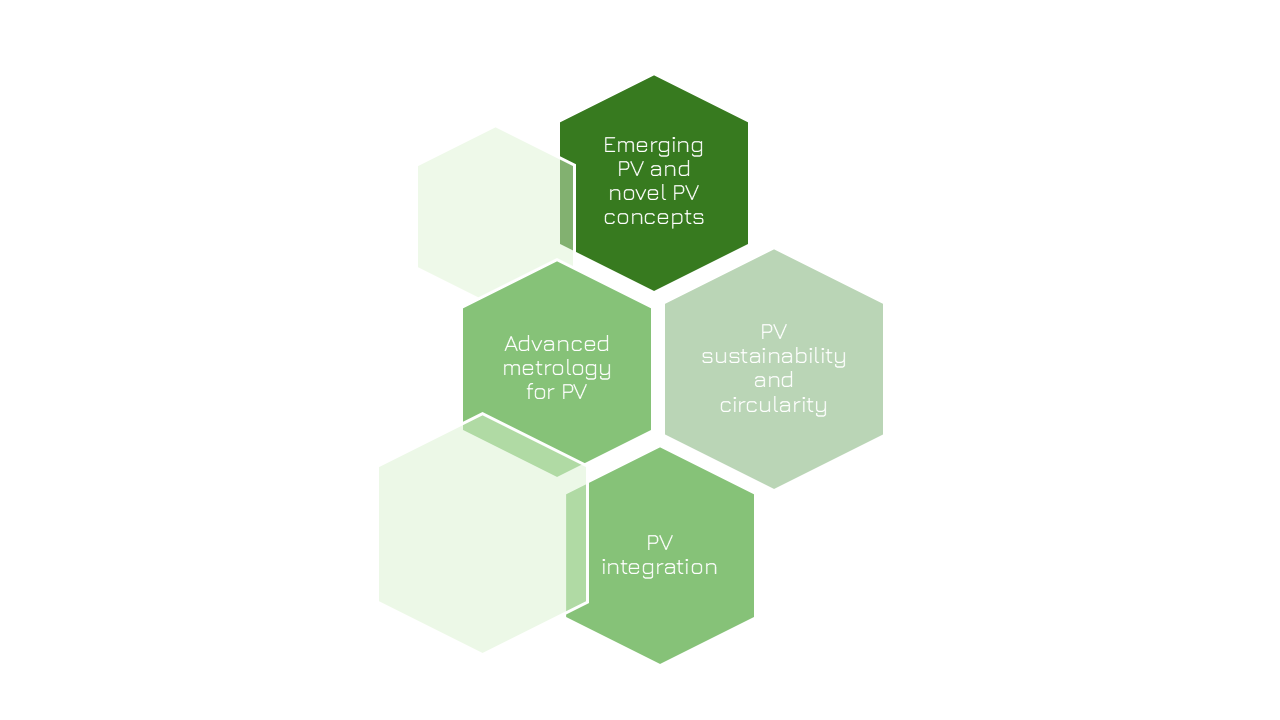
Taking PV to the next level: emerging PV and novel concepts, advanced metrology for PV, circularity and sustainability, and PV integration.
Mission
Our mission is to contribute to the acceleration of clean energy transition towards a more climate neutral circular economy by enhancing zero-emission power technologies, particularly photovoltaics (PV). To this end, worldwide research and industrial efforts are focusing on increasing overall energy conversion efficiency and lowering the cost of PV technologies, as well as enhancing sustainability, circularity, and integration prospects of PV into the natural and urban environment.
New and emerging thin film technologies such as perovskite-based PV, tandem solar devices, and other novel thin film and nanoscale technologies are considered excellent candidates to achieve these goals, some already achieving high efficiencies rivalling those of established thin-film technologies as well as crystalline silicon. Moreover, they offer the advantage of tunability of desired opto-electronic properties, mechanical flexibility, and the potential for scalability and reduced environmental footprint. The main challenges that need to be addressed to make such technologies mainstream include the device stability, field reliability, reproducibility, upscaling, standardization of appropriate measurement protocols, and any toxicity issues. These challenges can be translated as key opportunities for the PV research community to capitalize on, ranging from basic research on stability to the development of appropriate international test protocols and ultimately field diagnostics for such emerging technologies.
The Photovoltaic Technology Group aspires through advancing emerging photovoltaic technology solutions and metrology to contribute to global efforts to significantly increase PV deployment towards tera-watt (TW) scale solar PV albeit in a more circular, sustainable, and effective way.
Key Research Focus Areas
The Group’s track-record and focus is on advanced metrology of new generation PV for investigating device stability, field reliability, circularity, and for contributing to the development of new, standardized measurement protocols and methods. The research in this area targets to address the following key challenges:
Long-term outdoor stability and reliability of meta-stable devices. Approach: Ensure field reliability of metastable devices through real-time monitoring, supervision and control of both electrical and environmental parameters.
Lack of IEC standards and accurate measurement protocols and measurement methods for meta-stable devices. Approach: Development of both indoor and outdoor advanced measurement protocols for the accurate and reliable assessment of metastable devices.
Developing new techniques to address the fundamental degradation mechanisms of novel energy technologies. Approach: Set-up of measurement techniques and methods that will act complementary in a holistic approach and assist on the understanding of fundamental processes and degradation paths in metastable devices.
Sustainability and Circularity issues of novel PV technology. Approach: Develop and test innovative circularity strategies for novel PV technologies combined with low environmental impact manufacturing of the devices. Investigating the link between material recyclability, material sustainability and degradation pathways generated through aging (accelerated indoors, outdoor).
Innovative indoor and outdoor applications of emerging PV technologies e.g. BIPV, IoT, agri-PV. Approach: Discover in the lab and in real operating environments the diverse applications of PV technologies across different areas for effective integration into energy markets.
Major R&D priorities
Standardisation – Research into accurate assessment methods and procedures for emerging PV technologies indoors and outdoors in direct support of the IEC in the development of standards relating to new photovoltaic technologies and their qualification test protocols.
Scaling – Research into the technical challenges arising from large-scale deployment of current and future PV technologies to support local and EU RES policy making actors.
Commercialisation – Applied research to support the commercialisation of next-generation photovoltaics through collaborative projects involving Industry, Government and Academia.
Forecasting – Predictive modelling of novel PV technologies utilising advanced statistics, machine learning, and AI for predictive modeling, big data analysis, and optimization of new and emerging PV technologies.
Reliability – Research into the long-term reliability of next generation photovoltaics using large datasets of outdoor data from different emerging technologies towards the understanding of their long-term field operation and degradation mechanisms.
Measurements – Development of novel and advanced characterization techniques for correlation of indoor and outdoor performance.
Applications – PV integration in different environments and infrastructure e.g. BIPV, IoT, agri-PV.
Selected projects
Recent work
Selected journal papers
Team members



Matthew Norton
Team member
Andreas Polydorides
Team member